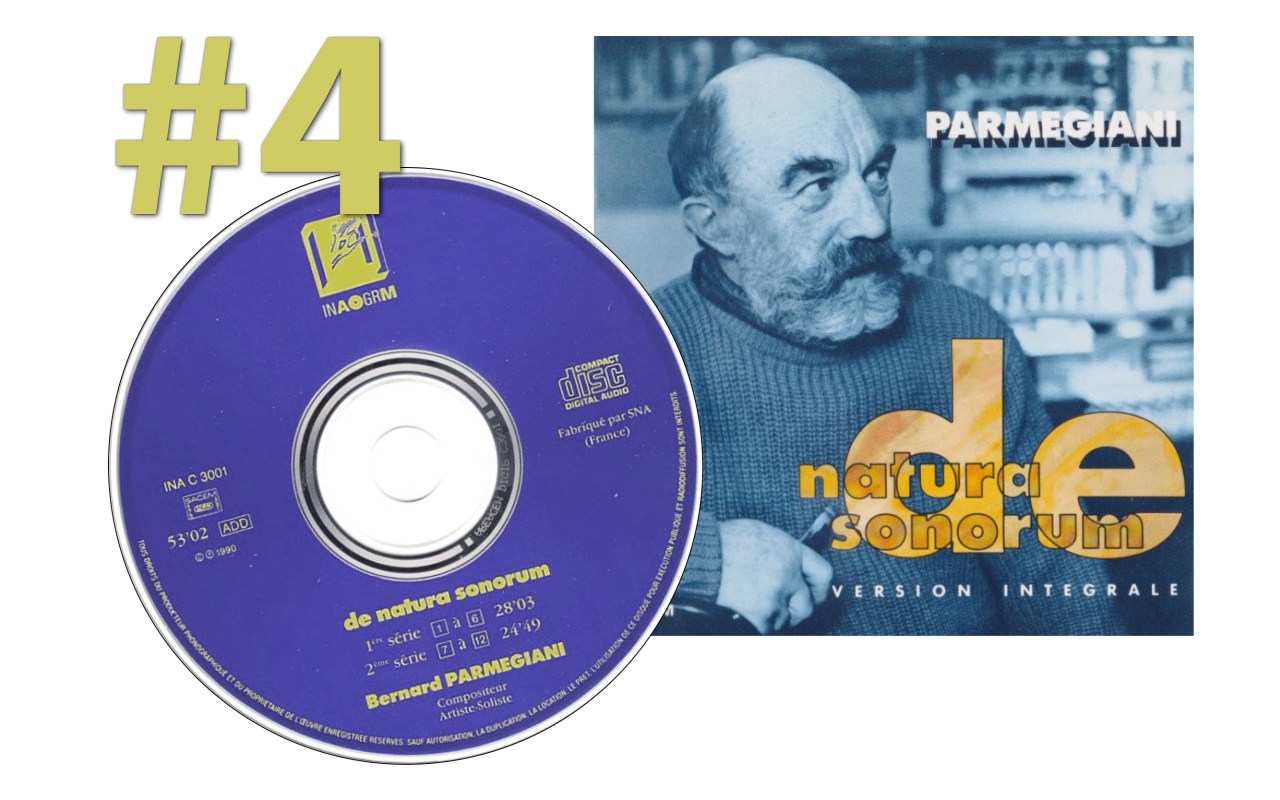
This analysis is the third in a series dedicated to selected movements from Bernard Parmegiani’s suite De Natura Sonorum (1975). These reflections stem from personal research developed over the years with the aim of better interpreting this milestone of acousmatic music, especially in the context of live performance on the acousmonium. The analyses presented on this website have been refined and adapted through repeated use in various workshops on acousmatic practice, interpretation, and musical analysis since 2010.
All spectrograms in this analysis are made with SpectroScore by Studio Lye.
Dynamique de la Résonance is one of the shortest (three minutes only) pieces in the suite and is built around a single, clearly defined idea: the progressive emancipation of resonance from its trigger. The trajectory is simple but radical — by the end of the piece, resonance loses its role as acoustic consequence of a physical event (the attack) and becomes an autonomous sound object in its own right.
This conciseness and clarity give me the opportunity to indulge in more general considerations and at the same time go deeper in detail regarding the sounds used in the composition.
The material that opens the piece is immediately appealing. There is something inherently fascinating about those three strikes followed by their resonances. An attack that resonates for a long time is, in my opinion, one of those sounds that naturally draws attention, rich in information about its source and the surrounding space, and somehow satisfying to listen to. The resonance lets us listen to the inherent harmonies that would be too short to hear when they are only contained in the attack. When we hear a resonance, we are not just hearing a sound: we are hearing a space, a material, a size… Resonance (or more generally, impulse response) is one of the most powerful acoustic indices we have. We use it constantly and unconsciously, to imagine the room a voice was recorded in, to assess the mass of an object, to locate ourselves in an environment. In everyday listening this happens automatically, below the threshold of conscious attention: Denis Smalley writes that we are simply not used to listening to space as a primary element:
“Focusing on space as the key, integrating element requires a reorientation of listening priorities and attentions: in my experience we are not that used to listening out for spatial attributes, for spatial forms, and space-form, partly because there is so much else to listen out for.”
Smalley, Denis. “Space-form and the acousmatic image.” Organised Sound 12, no. 1 (2007): 35–58.
The fact that “there is too much to listen out for” before we focus on space applies equally well to resonance as an index of spatiality. Think of how we listen to a voice on the radio: the first thing we process is the semantic content, what is being said. Then we register the timbre, the character of the voice, its connotations of age and physical presence. And only very peripherally do we pick up the spatial qualities embedded in the audio signal: the acoustic environment, the distance of the microphone, the presence or absence of room reflections to name a few. Radio producers have long known this, and have traditionally sought to strip voices of any spatial indices, recording in acoustically dead environments and using close microphones, to make the voice as “clean” as possible, freed from any implication of a specific place. The voice becomes pure signal. Of course, once that voice is played back in a physical space, it immediately acquires the resonance of that space, but that is another matter…
In acousmatic music, the utopia of reduced listening (écoute réduite) asks us to perform a similar operation voluntarily: to hear a sound for its intrinsic qualities, ignoring questions of source and cause. In practice, this is difficult, and Smalley is honest about it when he points out that we always tend toward source bonding, that is, toward identifying what made the sound, and letting that identification color everything we hear subsequently. As he notes, “identified sources carry their space with them”: as soon as we recognize a sound as belonging to a particular object or environment, we automatically import all the spatial and material associations that come with it.
Dynamique de la Résonance dismantles this mechanism step by step. It begins with sounds whose source bonding is strong, percussive strikes as clear physical causes originating resonances, and progressively weakens that bond, until the resonance that remains carries no source with it at all. This is done mainly through two techniques: showing resonance as an element capable of its own articulation (unnatural length and steadiness, glissandos, crescendo); and hiding the attack, the source itself.
The second technique connects to one of the early discoveries of the musique concrète pioneers: removing the attack from a recorded sound. The attack is the moment in which a sound’s physical origin is most clearly encoded, the instant of contact between cause and effect. Without it, the sound becomes spectrally ambiguous, difficult to attribute to a specific source, and therefore available for a different kind of listening. Parmegiani does something similar here, separating the resonance from its trigger. In the process, the resonance undergoes a sort of promotion: from being a parameter of the attack, a byproduct, a spatial index, to being an autonomous sound object, with its own morphological life.
I would divide the compositional processes happening in Dynamique de la Résonance in four different phases:
Part 1 (0:00–00:36): attack+resonance; first appearance of the glissando.
Part 2 (0:36–1:08): dialogue, space, and increasingly unnatural behavior.
Part 3 (1:08–1:51): resonant background and the reversal of roles.
Coda (1:51–2:53): resonance alone.

First part (until 0:36)
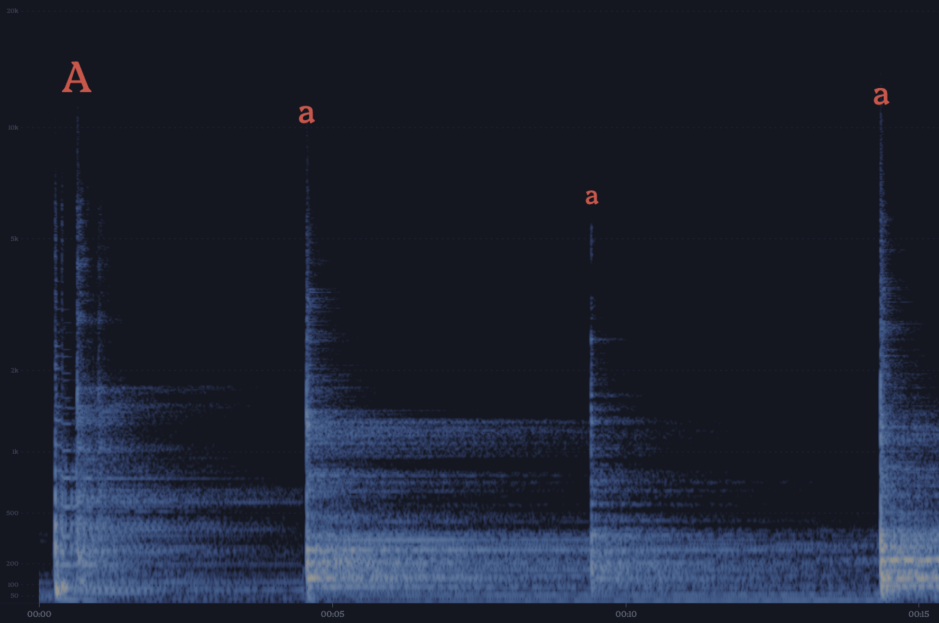
The piece opens with a group of three sounds, which we may call Element A: two closely spaced and one more distant (the first time this group appears, the third sound curiously triggers a delay). The first two are lower in register and seem to trace a descending melodic contour of a semitone, while the third has a broader spectrum with a more prominent high-frequency content. All three are followed by resonances that linger for almost five seconds. Around the five- and ten-second marks, two more sounds appear. They are similar in character to the third strike, but weaker, shaping a decrescendo and rallentando, an echo of the opening gesture gradually losing energy.
This initial triplet, two sounds close together and one more distant, functions as a rhythmic, melodic and timbral motif that will recur throughout the piece. It reappears shortly after 0:15, preceded by a stronger impact:
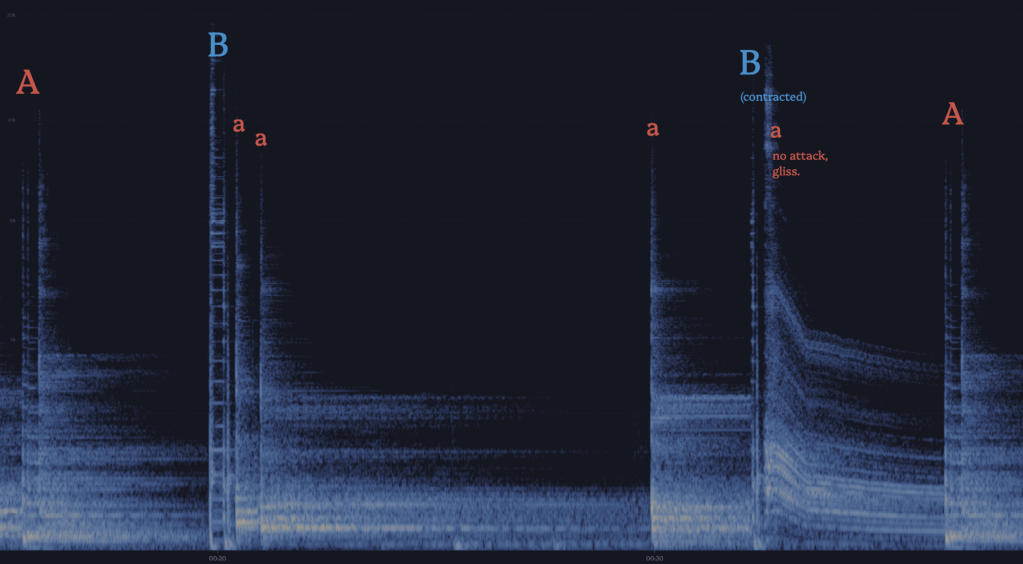
Figure 2: Spectrogram from 00:15 to 00:38. B is a clearly harmonic element with a metallic feature.
The timbre of all these strikes is not easy to describe precisely. It does not suggest a resonant object so much as somebody hitting something between metallic and wooden, dry and muffled, subsequently immersed in reverberation, whether artificial or from a naturally reverberant environment. The resonance here feels external to the object, applied rather than inherent.
Something quite different appears at 0:20. Element B is clearly metallic and intrinsically resonant, but its resonance seems to be forcibly stopped almost immediately after the strike, as if damped by hand. While Element A is a dry object triggering an external resonance, Element B is an already resonant object whose resonance is being suppressed. The dichotomy is clear, and in some sense symmetrical: one material has resonance imposed on it from outside, the other has resonance emerging from within, although stopped.
Element B returns in an even more contracted form at 0:32, where the natural resonance is barely audible (and visible in the harmonic spectrum) before being cut short. Immediately after this, something anomalous occurs for the first time: a resonance derived from element A appears with a very clear downward glissando, and its attack seems weakened, perhaps absent. Natural resonances do not glide in pitch, and they do not happen without a trigger: this is the first sign of a resonance beginning to detach from its trigger, the first crack in the causal logic of the piece.
The section closes at 0:36 with an almost literal restatement of the opening strikes (Element A), leading into the second part 2.
Second part (0:36-1:08)
From 0:40, Elements A and B enter into dialogue. For the first time, the stereo image becomes an explicit compositional parameter: sounds are occasionally placed left, right, or center, creating a spatial conversation between materials which underlines their individual characters. Space here draws the listener’s attention to itself, “reorienting our listening priorities” as Smalley would say.
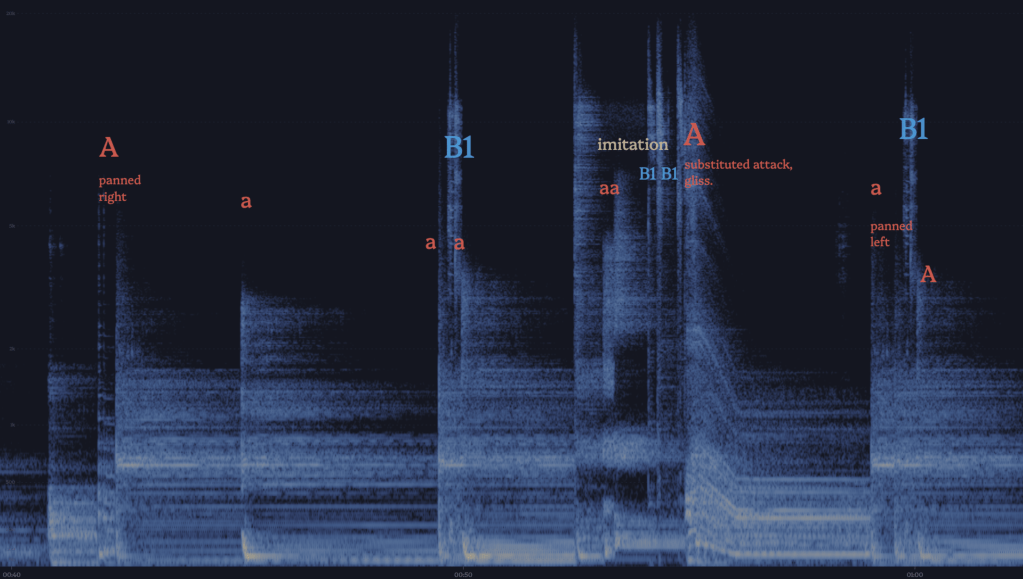
The resonances associated with Element A in this section are increasingly anomalous. They are unnaturally static, lacking the characteristic decay of a real acoustic resonance, and fade so slowly that they are often cut off by the onset of the next sound rather than dying away on their own. Even more striking is the dramatic glissando heard at 0:55, which defies any acoustic logic. Few seconds before this moment, a brief passage places Element A (resonance only, without any audible attack) and Element B in something close to melodic imitation, pairs of closely spaced sounds that seem to respond to one another across the stereo field.
A sort of first variation of Element B, called B1 in Figure 3, appears episodically in this section. First heard at around 0:49, it is clearly metallic and resonant in a more natural way than anything before. It actually sounds quite similar to a half-open hi-hat: a short but audible natural decay, without the external reverberation of Element A or the forced damping of Element B.This first occurrence at 00:49 constitutes, together with sounds coming from Element A, a rhythm that clearly recalls the opening of the piece.
B1 is part of a process that will gradually free element B’s natural resonance.
Other “extraneous” sounds (Figure 4) make their appearance in this sort of climax, and only here. A drier, more compact sound (its spectral range makes us think about a further variation of B) appears at 1:04, followed by a brief glissando. Shortly after, at 1:07, a very short sound with a defined pitch is repeated rapidly four times, perhaps echoing the two closely spaced attacks of the opening theme. All these short gestures prepare the arrival, at 1:08, of a large resonant strike whose behavior strongly recall a Chinese opera gong (variation of A: Element A1), with its upwards glissando at the attack: a broad, rich resonance that seems to open a new space in the piece.
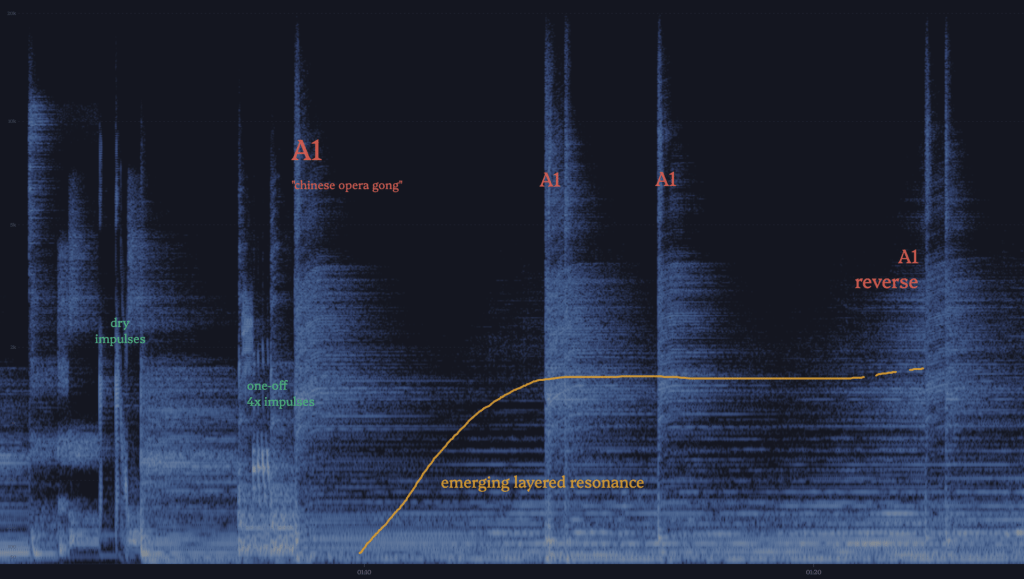
Third part (1:08–1:51)
The A1 strike at 1:08 marks a turning point: concurrently, a composite metallic resonance emerges in the mid-low register, built from multiple sustained layers that accumulate, overlap, and gradually solidify. This resonance establishes itself as a kind of keynote: a persistent, artificially constructed background against which everything else now occurs, and which will remain present until the very end of the piece, that is for almost two more minutes.
Against this backdrop, further occurrences of A1 appear. Some arrive naturally, as strikes generating resonances; others are heard in reverse, growing from silence rather than decaying into it, as if the resonance were not the consequence of a strike but a sound arising on its own, without physical cause. The event at 1:20 is one such reversed resonance: here the dissociation between attack and resonance reaches its most explicit form: we are hearing a resonance that has no attack, that simply materializes and grows. It is no longer the tail of an event, but an event itself.
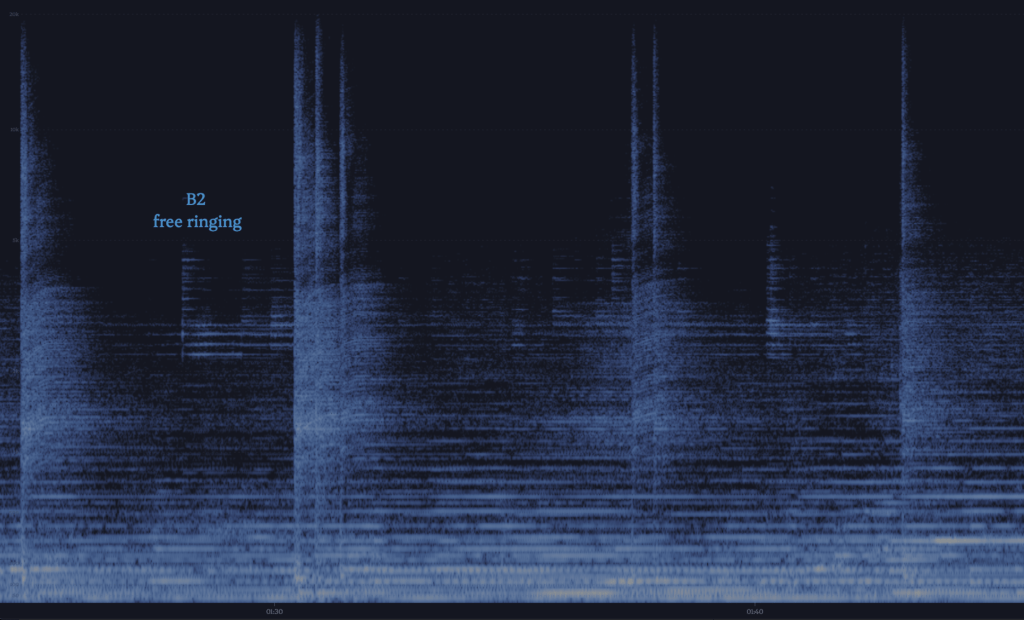
A further variation of the B family, indicated as Element B2 in Figure 5, returns more prominently at 1:28. Heard here as a naturally resonant metallic object, freely ringing and unprocessed, it creates a contrast on one side with the artificial background resonance, which is entirely constructed through loops and layering; and on the other side with the “Chinese opera gong” strikes, which occupy a middle ground between natural behavior and artificial elaboration through glissandi and reversal. In this way, Element B2 serves as a reminder of what causal resonance sounds like, and of how far everything (elements A and B) has moved from that starting point.
As the background resonance and Element B2 grow in presence, the percussive strikes, occasionally recalling the rhythmic theme from the opening of the piece, make their final appearances between 1:43 and 1:51. After this point, there are no more attacks.
Coda (1:51-2:53)
After 1:51, the A1 strikes disappear entirely. What remains are traces of the resonances that accompanied the final A1 strikes, gradually absorbed into the layered background. This composite resonance diminishes slowly over the course of about a minute, its higher spectral components fading first. Element B2 is also present, but heard for the last time at 2:19. After this, only the lower-register components of the resonance layers remain, fading until the piece ends at 2:53.
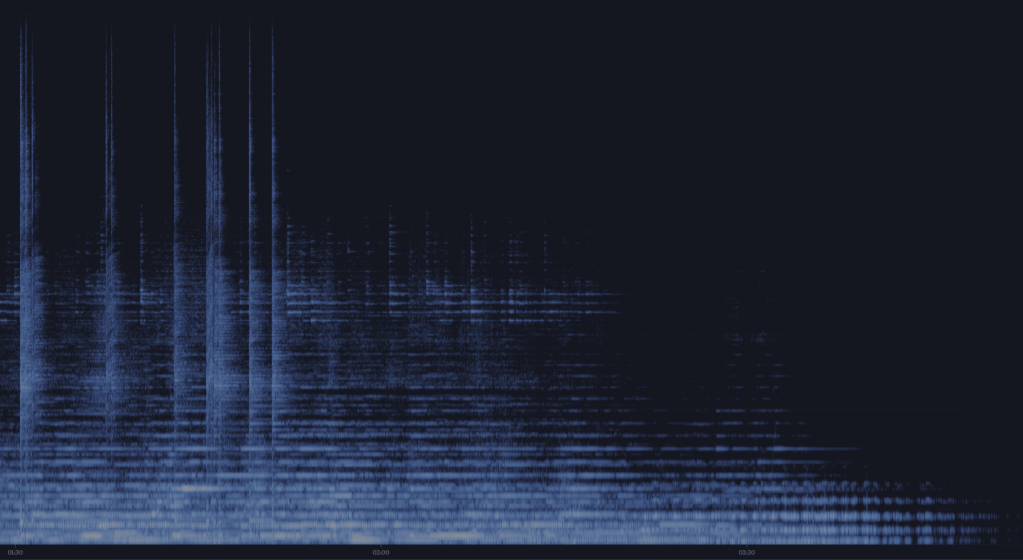
It is worth noting the proportions here. This final section, built entirely from resonance with no attacks, no percussive triggers, no causal events, occupies roughly one third of the total duration of the piece. This is not a brief fade-out. It is a substantial section of the work, in which the listener is given time to focus on resonance as the sole protagonist: no longer a spatial or timbral index of anything, no longer carrying a source, no longer pointing to an object, a room, or a physical cause.
One further observation concerns the texture of the resonant background that pervades the coda. On close listening, the accumulated resonance exhibits a kind of internal roughness: a continuous, fine-grained activity within the sound mass that suggests the friction of a material being bowed or rubbed, rather than the decay of a struck object. It is as if the sound were produced by the friction of a mallet on the rim of a singing Tibetan bowl, especially in the lower areas of the spectrum. The resonance, in other words, no longer sounds like a resonance at all, but rather as the continuous excitation of a vibrating body. And within this texture, one can perceive what seem to be small internal attacks, brief and almost incidental impulses embedded inside the resonant body (possibly related to element B2).
This is the final and most complete subversion that Parmegiani shows us in this piece. He began the composition with attacks generating resonances: cause producing effect, following the natural acoustic order. The piece ends with a resonance that contains micro-attacks: the former protagonist has become a subordinate detail inside the material that was once its consequence. The hierarchy is first disrupted and then fully subverted. What was tail, parameter, effect, has become body, object, cause.
 Alessandro Perini