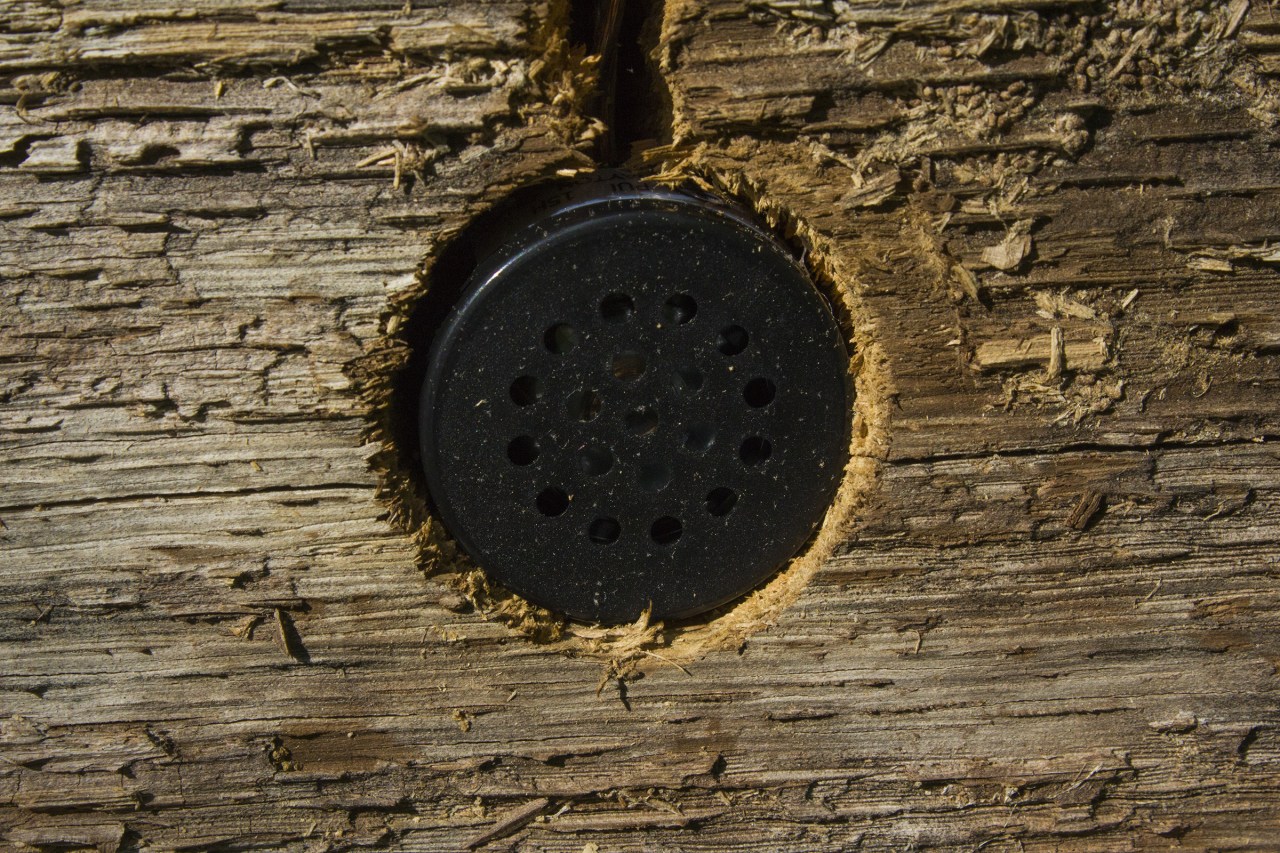
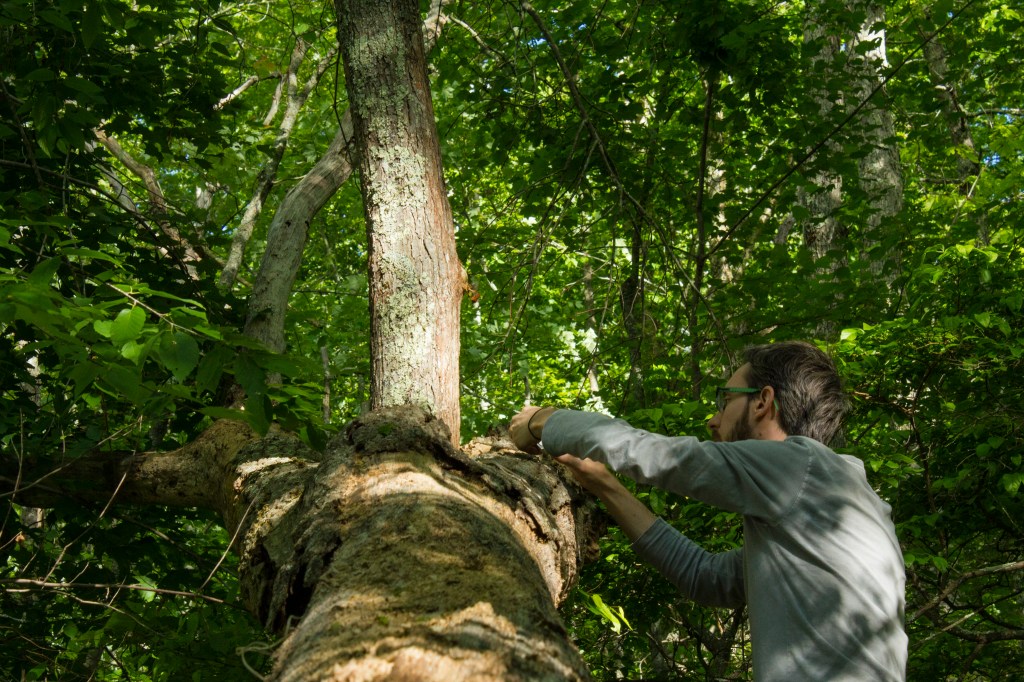
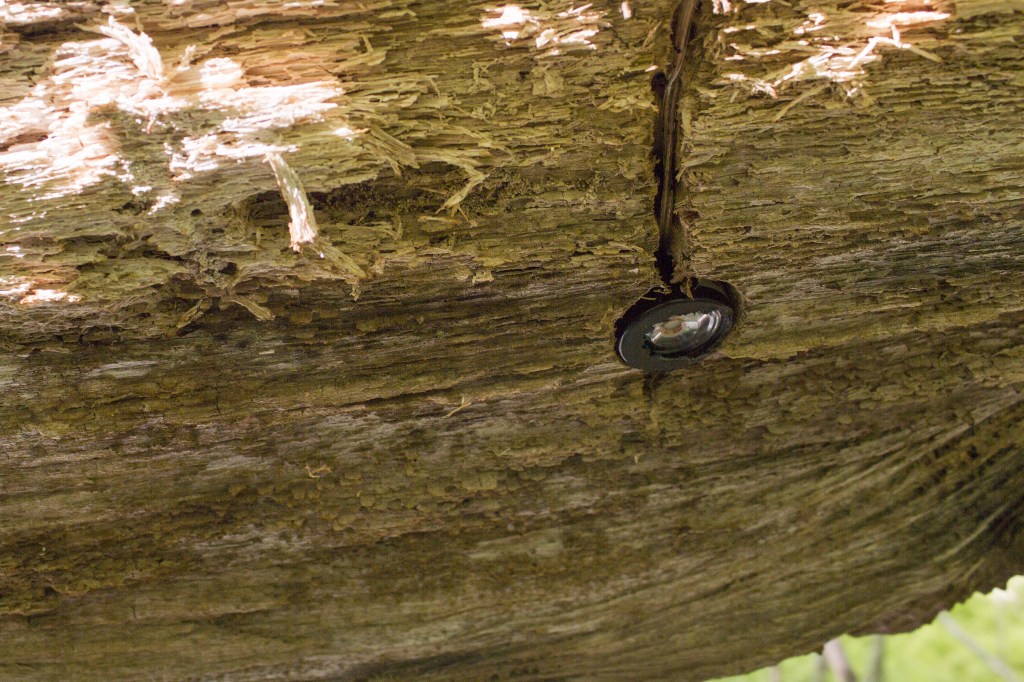
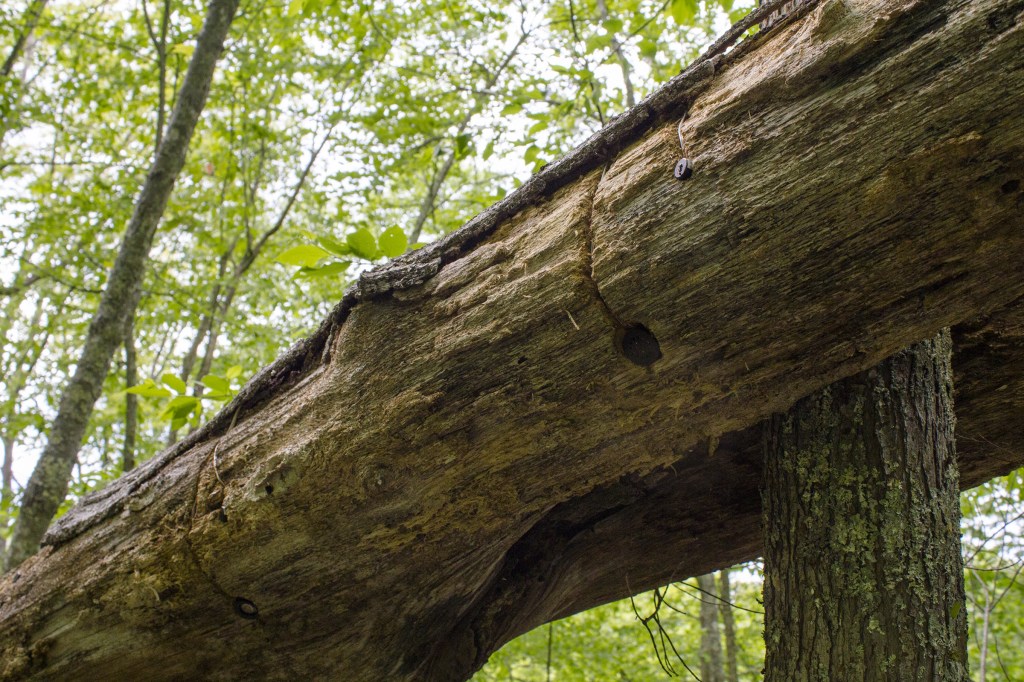
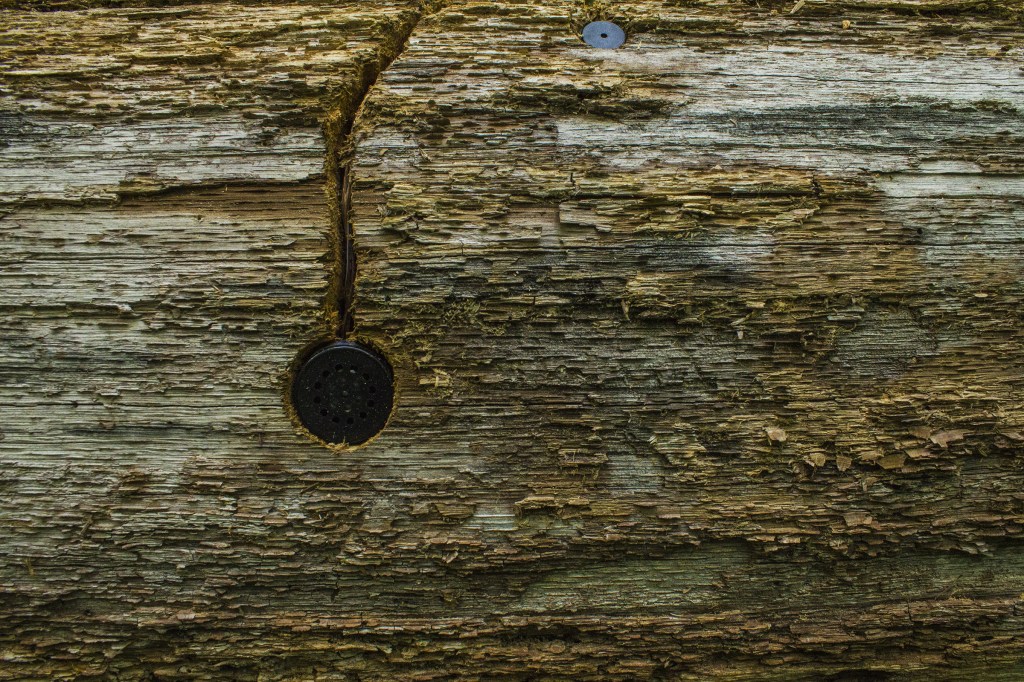
20 micro-speakers are embedded in a dead tree, determining an analysis in time, space and sound frequency of the tree itself. A dead tree can rot or can become an artifact. How would it sound if it were to become a musical instrument? What if we would cut the tree at different heights and make a resonant pipe out of it? The distance of each speaker from the root determines the frequency it will emit. Small instrument, higher pitch; big instrument, lower pitch. Altogether, the twenty speakers create a virtual, ever-changing — and at the same static — spectrum derived from an incidental, yet very concrete, physical feature.
“Dead Tree Spectrum” is a sound exploration of a dead tree trunk, found along the trails of I-Park, in East Haddam (Connecticut, USA). This site-specific sound-art intervention includes ten 32mm and ten 17mm-diameter minispeakers, embedded in wood and emitting different sets of frequencies.

The wood has been carved in order to host the twenty sound devices, custom-made cables and ten mp3 players.
Each speaker is embedded at a certain distance from the roots. The diameter of the tree is around 120 cm. Diameter and distance from the roots are used to calculate the fundamental frequency of a virtual pipe, as if the tree would be cut in that particular position and become a resonating musical instrument (for example, an organ pipe):
| Distance from roots (cm) | Speaker | Fundamental Frequency (Hz) |
| 130 | 1a | 58.6481249 |
| 136 | 1b | 56.34144423 |
| 190 | 2a | 41.61179751 |
| 198 | 2b | 40.0602185 |
| 252 | 3a | 32.00497483 |
| 260 | 3b | 31.07914606 |
| 313 | 4a | 26.08086129 |
| 324 | 4b | 25.23843642 |
| 376 | 5a | 21.89518841 |
| 385 | 5b | 21.40445073 |
| 439 | 6a | 18.86722043 |
| 447 | 6b | 18.54160914 |
| 500 | 7a | 16.63917669 |
| 508 | 7b | 16.38541079 |
| 560 | 8a | 14.90758856 |
| 568 | 8b | 14.70356786 |
| 621 | 9a | 13.48125329 |
| 630 | 9b | 13.29359433 |
| 685 | 10a | 12.25140831 |
| 695 | 10b | 12.07922963 |

The speakers are arranged in ten pairs (one 37mm and one 17mm for each pair). The composition of each track for each speaker pair involves the fundamental frequencies at different higher octaves, both because the speakers are too small to emit low frequencies, and because the lowest frequencies are too low to be heard anyway.
Made at the I-Park residency for the Site-Responsive Art Biennale, I-Park Foundation, East Haddam CT (USA) – May/June 2017


 Alessandro Perini