This analysis is the second in a series dedicated to selected movements from Bernard Parmegiani’s suite De Natura Sonorum (1975). These reflections stem from personal research developed over the years with the aim of better interpreting this milestone of acousmatic music, especially in the context of live performance on the acousmonium. The analyses presented on this website have been refined and adapted through repeated use in various workshops on acousmatic practice, interpretation, and musical analysis since 2010.
Among the pieces constituting De Natura Sonorum, “Étude Élastique” is one of the most pedagogically emblematic, and in general is one of the most significant works in Parmegiani’s entire output for its clarity in the development of the material: it is a sort of manual of composition for understanding the dialectical potential of duality, with its form emerging from the clash between two very different, almost opposite materials. The listener is confronted with a dialectic between two typologies of sound, which progressively merge into a third, hybrid sound matter. We can define the form of this piece as divided in three parts, with the end of the third part being the culminating moment, plus two epilogues:
Part 1 (0:00–1:35): introduction and juxtaposition of the two contrasting elements.
Part 2 (1:35–2:26): attack and resonance logic established.
Part 3 (2:26–4:22): gradual fusion of elements A and B, and culmination.
Epilogue I (4:22–6:02): spectral disintegration, eight large waves of white noise.
Epilogue II (6:02–end): reiterated sine waves emerging and fading away.

On a side note: in some way the dialectic between A and B resonates strongly with the classical sonata form, where two contrasting themes (and harmonically opposite poles) are set in opposition, elaborated, and finally reconciled in the recapitulation. In many of the classical sonata forms (Haydn, Mozart, …), the first theme may be quite assertive, exhibiting clarity in rhythm (strong downbeats, few syncopations), harmony (few or no non-harmonic tones) and other parameters; the second may be on he contrary more lyrical, legato, and sometimes ambiguous — its phrases often softened by appoggiaturas or cadences that blur metric emphasis. We are often taught that these elements often should interact, fight, influence each other, but this is not always true, especially in the first part of the classical period, where juxtaposition and introduction of new elements seemed to be the rule.
In Étude Élastique this contrast is not merely on the symbolic level but is audibly enacted in the concrete processing of the elements. The piece becomes a laboratory for development, not just in terms of form and phraseology but of sound matter itself. Whereas in instrumental music the idea of conflict or contrast might be encoded through harmonic or motivic means, here it’s rendered through the elaboration of the parameters of sound as well.
What makes the piece so emblematic is that the dialogue/contrast between A and B eventually produces a third material, one that integrates its origins: a dense, saturated, granular mass exhibiting features of both materials, the product of interaction/distortion and accumulation. Unlike the more linear transformation we might observe in piece no. 2 (Accidents/Harmoniques), here the process is episodic, and the materials acquire a sort of theatrical agency. They are not just sounds; they are characters in a narrative of collision and synthesis.
First part (until 1’35”)
Just like in the sonata form, the two thematic elements in Étude Élastique are presented in the opening section of the piece, from the very beginning until 1’35”. In this passage, the two materials are clearly separated: they seldom overlap, and their contrast defines the fundamental dialectic of the work.
The first element, which we will call A, appears to be produced using fast-sweeping band-pass filters applied to white noise, suggesting a synthetic origin. It is present as two distinct and independent voices located in the left and right channels. Each of the two voices exhibits a very narrow and localized spatiality (they never cross to the other stereo side). This material is harmonically unstable — it lacks a clear fundamental or dominant pitch. From a performative/vocal perspective, it could be imitated by producing a “shhh” sound while shaping the oral cavity, modulating its resonance.
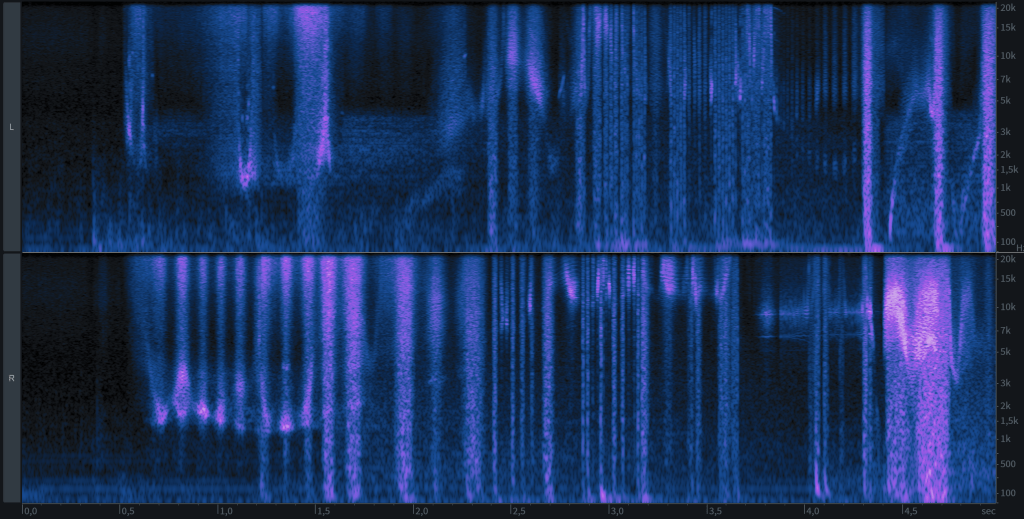
The second element (B) is instead a monophonic, spatially centered sound event, seemingly concrete in origin, reminiscent of a drum skin, but sometimes also of a rubber balloon excited in different ways. It is rhythmically articulated through multiple strikes, almost like a tremolo. Unlike the synthetic first element, this one shows, especially in certain moments, a recognizable pitch or tonal center and a much more stable spectral identity. It has a sharply defined attack — or rather, several attacks — whereas the first element fades in smoothly, with no perceptible onset. Though multiform in timbre, element B always refers clearly to a physical source, and its rhythmic profile contrasts starkly with the fluid continuity of Element A.
| Element A | Element B | |
|---|---|---|
| Origin | Synthetic (filtered white noise) | Concrete (percussive skin sound) |
| Pitch | Undefined, gliding filtered band | Recognizable fundamental pitch |
| Attack | Mostly absent, smooth fade-in/out | Discrete attacks, tremolo |
| Polyphony/Space | Dual (left and right) | Mono, centered |
| Behaviour | Glissando | Rhythm |
| Attack | No attack, continuous modulation | Clear attacks, repetition |
In this opening section, the second element is scattered and sporadic, often acting as punctuation. It is worth noting that, even in this early stage of the piece, the first element occasionally starts to resemble the second, adopting more percussive characteristics. These moments can be seen as anticipations of the work’s eventual trajectory, in which the two materials gradually integrate and give rise to a hybrid, third material. This happens when the glissato sweeps of the central frequency of the band-pass filter are so fast that almost create an audible attack.
From a spatial perspective, the contrast is also significant: as previously underlined, the synthetic, filtered noise is presented in stereo as two contrapuntal voices on either side, while the percussive sound appears mono, right at the center. In my opinion, this spatial differentiation must be considered a key interpretive clue when performing the piece over an acousmonium.
Second part (1’35”–2’26”)
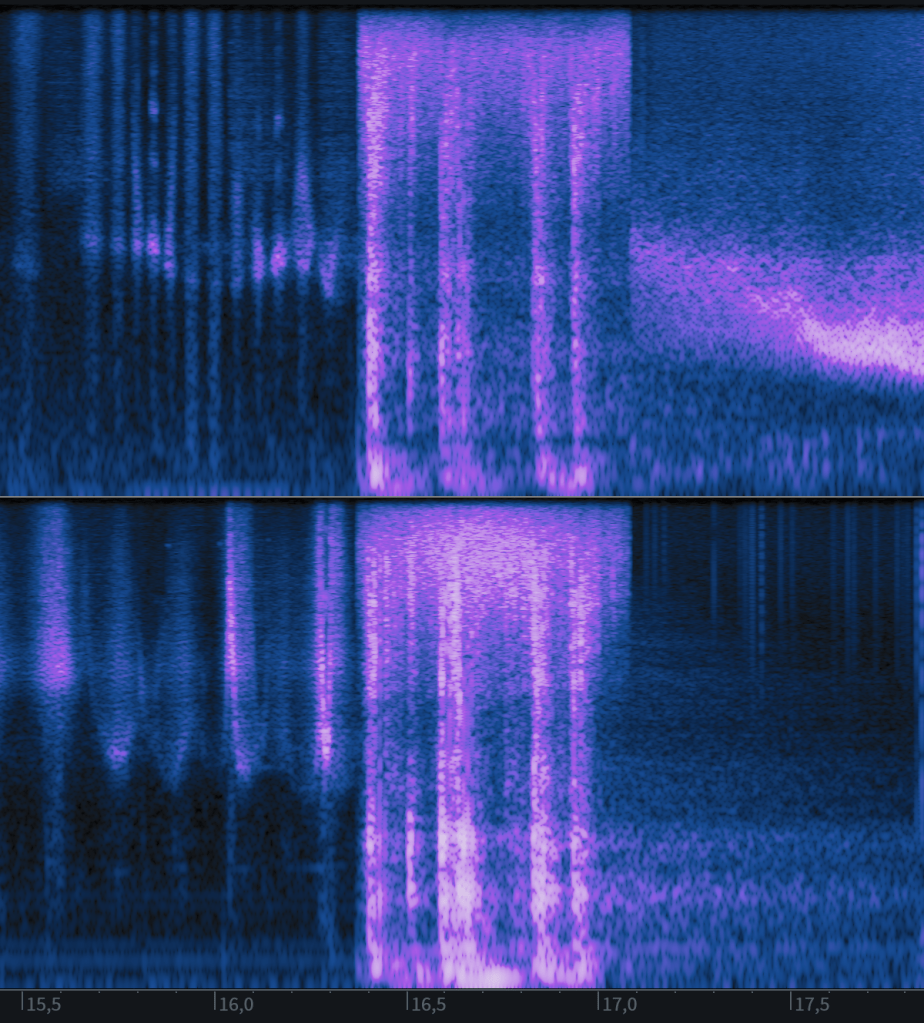
The second part presents a clear reordering of the two materials. The percussive Element B, previously sparse and inserted almost as punctuation into the continuous unfolding of Element A, now becomes the dominant actor. It appears in the form of isolated impacts — single attacks — each triggering a continuous trail of resonance.
These resonances are basically bands of noise (element A), now more clearly pitched, centered around a stable and recognizable frequency. This marks a transformation of Element A, which is no longer a gliding, unstable texture, but a static noise band, tuned to resonate with the pitch content of Element B.
In this way, a relationship of cause and effect is established: the percussive event (Element B) acts as a trigger for a resonant response (Element A), and dictates its center frequency. The first stage of their integration thus happens in the domain of temporal function — a syntagma of activation and reaction. While previously the white noise was articulated freely in time, it is now subordinated to a rhythmic structure. This dynamic shift can be interpreted as a reversal of roles: what was previously a minor element, a punctuation, becomes foreground, and vice versa.
Yet, this process is not definitive. Embedded within this section of functional exchange are moments of recurrence of Part 1 — brief passages in which the original texture of Element A resurfaces, with its continuous filtering and two-fold polyphony. These moments seem to momentarily interrupt the new hierarchical order, as if to resist the dominance of the percussive material or to reassert the independence of the earlier materials.
Third part (2’26”–4’22”)
The third part is marked by a progressive fusion between the two original elements. The textural opposition that had characterized the earlier sections begins to dissolve into a dense, hybrid material. The percussive element and the filtered noise start to merge, no longer alternating or triggering each other, but instead becoming intertwined in a single body. At the spectral level, the distinction between pitched resonance and noise becomes increasingly blurred: the white noise becomes the distortion of the vibrating skins, and the percussion acquires the frequency range of the noise.
This fusion is articulated temporally as well. In the first section of this third part (roughly until 3’17”), Element B — just established as the leader of the process in the previous part — behaves almost like a metronome, regularly punctuating the texture. This regularity retroactively balances the absence of pulse or rhythm in the opening section. What was once tremolo (i.e. an embryonic pulsation) now becomes macrostructure — a steady beat organizing the listening time.
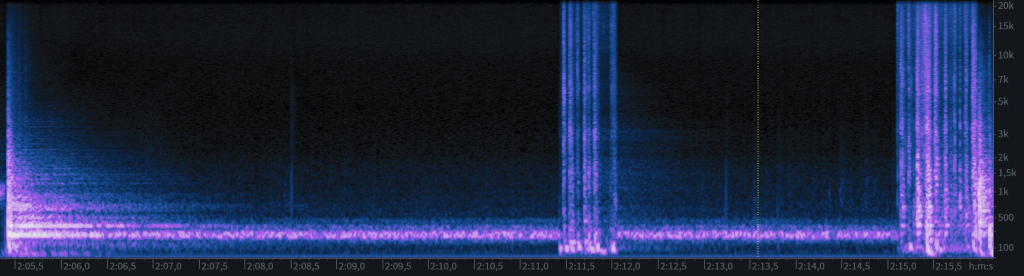
Then, after 3’17” (section two), a transformation occurs: the clear percussive pulse disappears, replaced by a low-frequency band of white noise that recurs at regular intervals, which seems to be a sort of transposed version of the resonances that follows the attacks in Part 2. This new element is rhythmically consistent in its recurrence, but lacks defined attacks — a kind of filtered throb in the low register. It assumes the role of the metronome without explicitly imitating its percussive gestures. Over time, the material begins to accelerate, and the structure gradually crumbles, eroded from within by the increasingly aggressive and distorted outgrowths of the new, hybrid material.
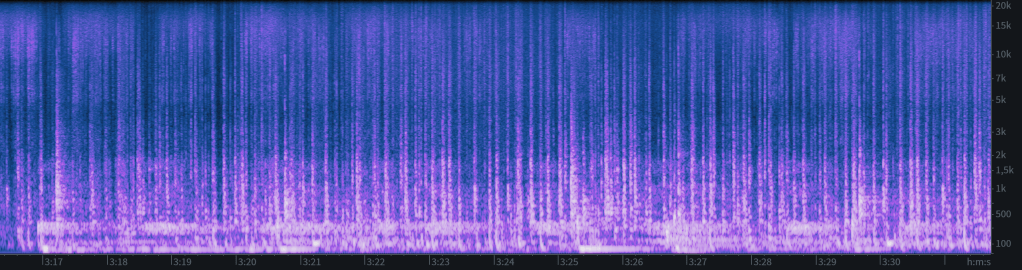
Meanwhile, the percussive/tremolo layer continues its evolution, producing more and more high-frequency content and pushing the texture towards granular spectral saturation. This leads directly into the next section: a series of massive, sweeping gestures — waves of noise that seem to emerge from the very collapse of the rich sonic mass just generated.
Epilogue I (4:22–6:02)
In the first epilogue, a series of broad noise waves emerges, seemingly attempting to wash away the entire frequency spectrum. These sweeping gestures occur predominantly in the mid-to-low range, dominating frequencies below 1000 Hz, and create a perceptual link to a key element from the previous section: the recurring, low-frequency metronome without attack. That earlier recurring figure, clearly linked to element A, returns here in expanded form, reinterpreted as a large-scale wave, aiming to erase or cleanse the layered transformations introduced by its hybridization with Element B. Therefore, we can say it shows features from both elements A (white noise and a gliding filter – this time a low-pass) and B (rhythm as recurring appearance in time).
As this section progresses, the white noise waves gradually break down and begin to disintegrate the more articulated, higher-frequency material that still lingers from the climax of Part 3. Around minute 5:40, that very material loses its internal tremolo articulation, becoming increasingly uniform and flattened. These broad noise bands, now devoid of internal articulation, yield almost imperceptibly to the second Epilogue — a sparse coda consisting of reiterated sine waves. This new material not only references the pitched quality that characterized Element B, but also echoes the quasi-metronomic recurrence of low-frequency pulses heard at the end of the previous section.

Epilogue II (6:02–end)
The second epilogue begins at 6:02 and closes the piece with reiterated sine waves, which mark a striking contrast with the densely saturated textures that preceded it. These tones are extremely bare, spectrally minimal, and appear almost as the skeletal residue of the entire previous sonic process. They evoke Element B, not in terms of rhythmic attack or percussiveness, but in the sense that they present a recognizable pitch — something that was completely absent in Element A.
However, these sine waves also recall another element from earlier in the piece: the low-frequency recurring band of filtered noise at the end of Section 3, which functioned as a metronome without attack, marking time in a steady, mechanical way. In Epilogue 2, this rhythmic regularity returns, now translated into pure frequency, without noise, without grain — only tone.
What makes this section particularly fitting its function is how it summarizes and completes the piece’s spectral narrative. If the beginning of the piece introduced gliding band-pass filtered noise (Element A), which then became fixed and harmonically anchored in Section 2, this final section represents the ultimate refinement of that filtering process: all excess spectral energy is now gone, and what remains is a stable, narrow set of tones.
 Alessandro Perini