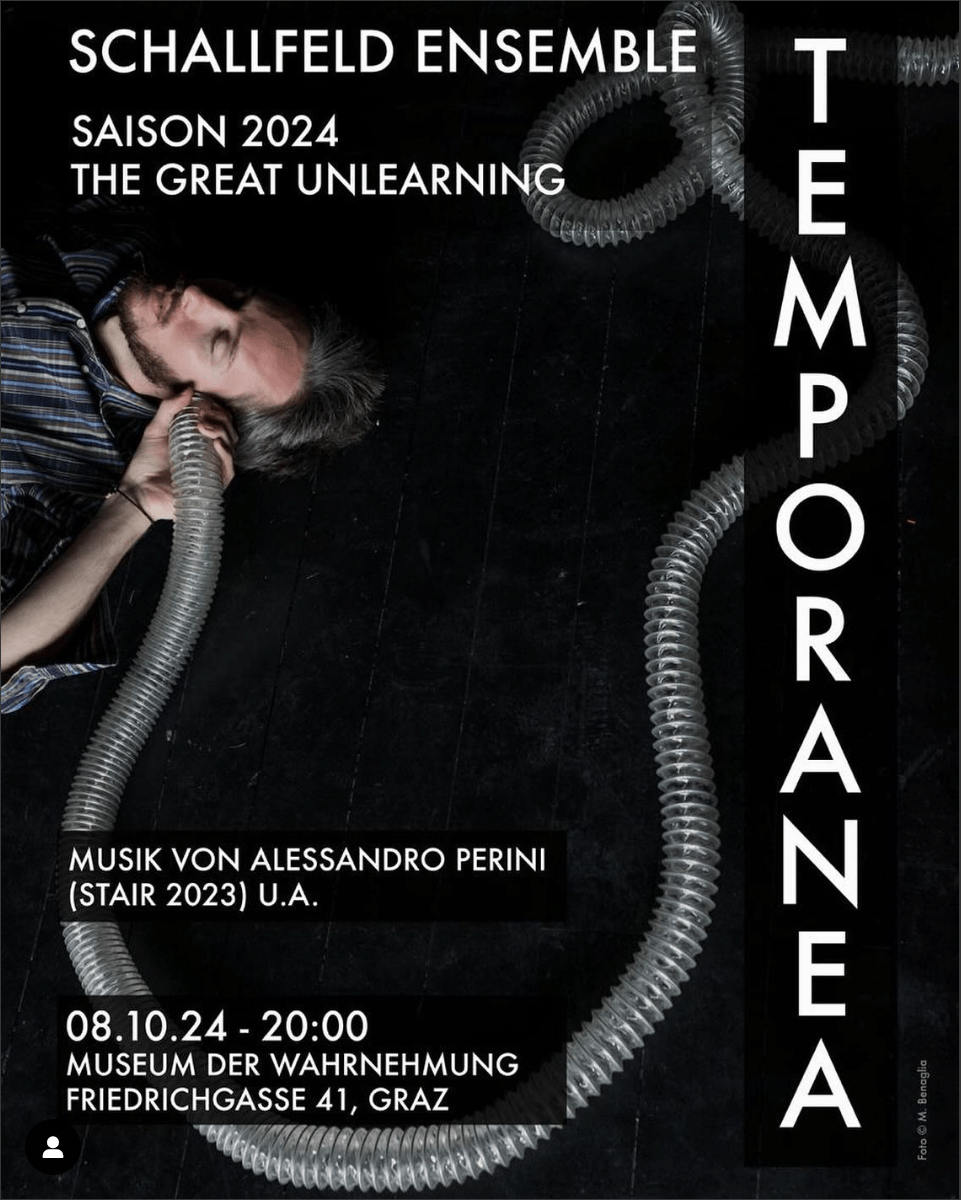
Alessandro Perini – “Temporanea. Aggregate” (2023-24)
for amplified trio with three rotating narrow-beam speakers
Schallfeld Ensemble:
Elisa Azzarà, Flute
Szilárd Benes, piccolo clarinet
Miriam García Fidalgo, cello and whisk
Davide Gagliardi, sound engineer
Written in the frame of the St.A.i.R. Residency – Graz (Austria).
❕ The sound projected by the Acouspade speakers is extremely difficult to capture accurately with microphones. Their unique emission results in a listening experience that cannot be fully documented through traditional recordings, but at the same time the way these speakers project sound causes significant distortions when picked up by any type of microphone, making it impossible to reproduce the actual spatiality and amplified sound as it was perceived in the room. Consequently, any recorded documentation of the piece can only provide an approximation of the real auditory experience.
This piece, written for three musicians of the Schallfeld Ensemble during my residency in Graz (St.A.i.R., October-November 2023), is an experiment on the interaction between sound projection, space, and movement. It employs a setup where each performer is amplified through a highly directional Acouspade speaker, which emits an extremely narrow beam of sound. The listening experience is thus fragmented: the sound is fully perceivable only when the listener is inside the beam, while outside of it, only faint reflections off the walls and surfaces of the space can be heard.
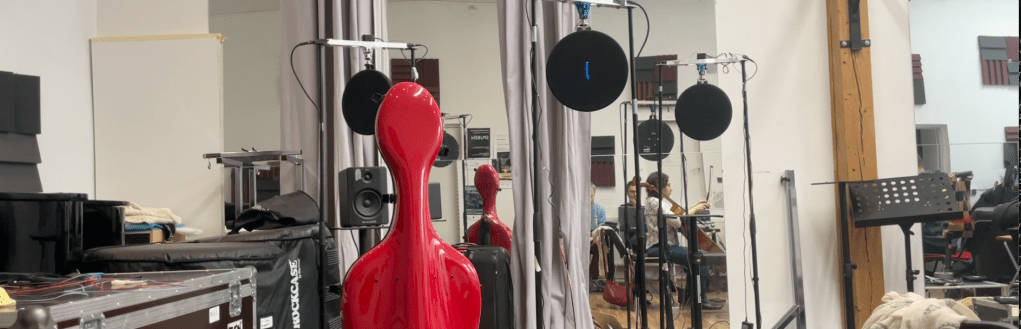
This principle of hidden or elusive sound is central to this piece. While spatial sound is often approached as a means to create immersive environments (e.g., Ambisonics, acousmonium), my interest here lies in sounds that are barely revealed—sounds that demand active listening and exploration. The directional speakers allow for a listening situation in which the perception of the sonic material is both precise and unstable, constantly shifting depending on the listener’s position.

Acouspade speakers use an array of ultrasonic transducers to project a tightly focused sound beam. This has peculiar perceptual effects: the sound appears as if it is happening inside the listener’s head rather than originating from a physical source. This illusion becomes even stronger when the sound beam arrives from behind. Such an approach completely disrupts traditional concert music perception, replacing it with an intimate yet fragmented listening experience where each audience member perceives a unique mix of direct and reflected sounds, layered one on top of another.
To expand this spatial dimension further, the Acouspade speakers are not static. Instead, they rotate during the performance. This movement is a fundamental compositional parameter, choreographed thanks to the use of Arduino and stepper motors. The orientation of the speakers continuously alters how the sound interacts with the acoustics of the venue, suggesting a site-responsive nature of the composition.
Here you find a blogpost with more technical details.
During the St.A.i.R residency, Margarethe Maierhofer-Lishka interviewed me for Radio Helsinki. Here is the recording.
Tests at the AVL anechoic room courtesy of AVL Cultural Foundation:
 Alessandro Perini
Pingback: Rotating directional speakers setup for “Temporanea. Aggregate”: technical details | Alessandro Perini